
Mobile robots · Primary: ISO 3691-4
AGV compliance: guided path, load, and plant as one system
Automated guided vehicles and forklifts on magnetic, laser, or vision guidance — guidance integrity, load handling, and door/lift/conveyor interfaces, validated at rated load.
Built for: AGV OEMs, automated forklift/tugger builders, and plant integrators
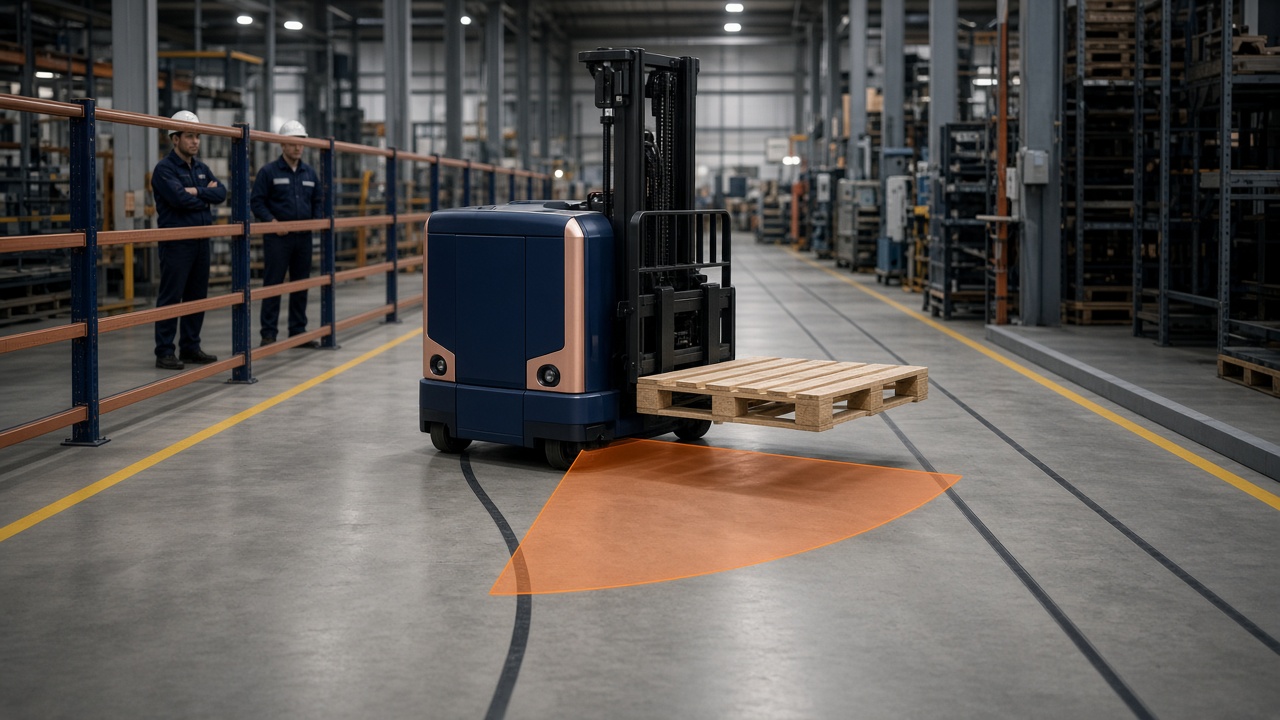 ISO 3691-4
What this category actually demands
AGVs trade AMR free-navigation for defined guidance — magnetic, laser, vision, or wire. That makes the path, the guidance integrity, and the load-handling cycle the centre of the compliance story: fork positioning, mast movement, load stability, and what happens when guidance is lost mid-aisle.
Customers will ask a deceptively simple question: “Show me it stops safely, with a load, every time.” We help you answer it with calculations, tests, and a technical file that survives a site acceptance review — not just a CE logo on the truck.
Reality check
Where AGVs — Automated Guided Vehicles programs stall
Guidance loss treated as a nuisance stop
Loss of guidance at speed with a raised load is a hazard scenario, with a designed detection and stopping response.
Load cases validated empty
Stopping distance, stability, and protective fields change with rated load and load centre. Empty-vehicle tests do not close the file.
Plant interfaces ignored
Doors, elevators, conveyors, and fire systems the AGV talks to are part of the system boundary and the risk assessment.
Safety architecture — AGVs — Automated Guided Vehicles
The safety architecture we build with you
Every function below ends as a claim in your file — with a target performance level, an implementation, and a validation method. If one of these is missing for your product, that is where we start.
Guidance monitoring
Loss/deviation of guidance detected and brought to a safe stop within a validated distance.
Load & mast interlocks
Travel speed and functions limited by fork height and load state.
Protective fields on path
Personnel detection field sets adapted to path geometry, crossings, and blind corners.
Interface safety
Doors, lifts, and chargers interlocked so the vehicle never assumes a state it has not confirmed.
How we help — from first sketch to site acceptance
One path, four gates. You keep design authority; we own the compliance thread through labs, assessors, and customer EHS reviews.
Gate 1
Domain & classification
Where it operates, who is exposed, which laws and type-C standards actually apply — before any test is booked.
Gate 2
Risk & safety architecture
ISO 12100 assessment turned into safety functions with PL/SIL targets your controls team can implement.
Gate 3
Validation
Measurements and tests on the real configuration — payload, speed, workpiece, ground — that close each safety claim.
Gate 4
File & acceptance
Technical file, DoC/DoI, instructions, and the site/customer acceptance pack, with change control that keeps it valid.
What you receive
- Guidance integrity & loss behaviour analysis
- Rated-load stopping & stability validation
- Path, crossing & interface risk assessment
- Interface interlock specification (doors/lifts/chargers)
- Technical file, DoC & commissioning records
Standards, in context
These are starting points, not a shopping list. The applicable editions and clauses follow from your classification and markets — EU Machinery Regulation (EU) 2023/1230, UK machinery rules, or North American OSHA/ANSI expectations, layered with EMC, electrical, radio, and battery law where your product triggers them.
| ISO 3691-4 | Driverless industrial trucks and their systems — safety |
| ANSI/ITSDF B56.5 | Driverless, automatic guided industrial vehicles (North America) |
| EN ISO 13849-1 | Safety-related control systems |
| EN IEC 60204-1 | Electrical equipment of machines |
Questions we hear from AGVs — Automated Guided Vehicles teams
Is an automated forklift an AGV for standards purposes?+
Generally it is assessed as a driverless industrial truck under ISO 3691-4, with load-handling functions analysed at rated capacity.
Bring us your project — at any stage
Sketch, prototype, or a customer audit next month. A 30-minute scoping call maps your domain, standards, and evidence gaps.
Book Free CallKeep exploring Robotics
All Robotics →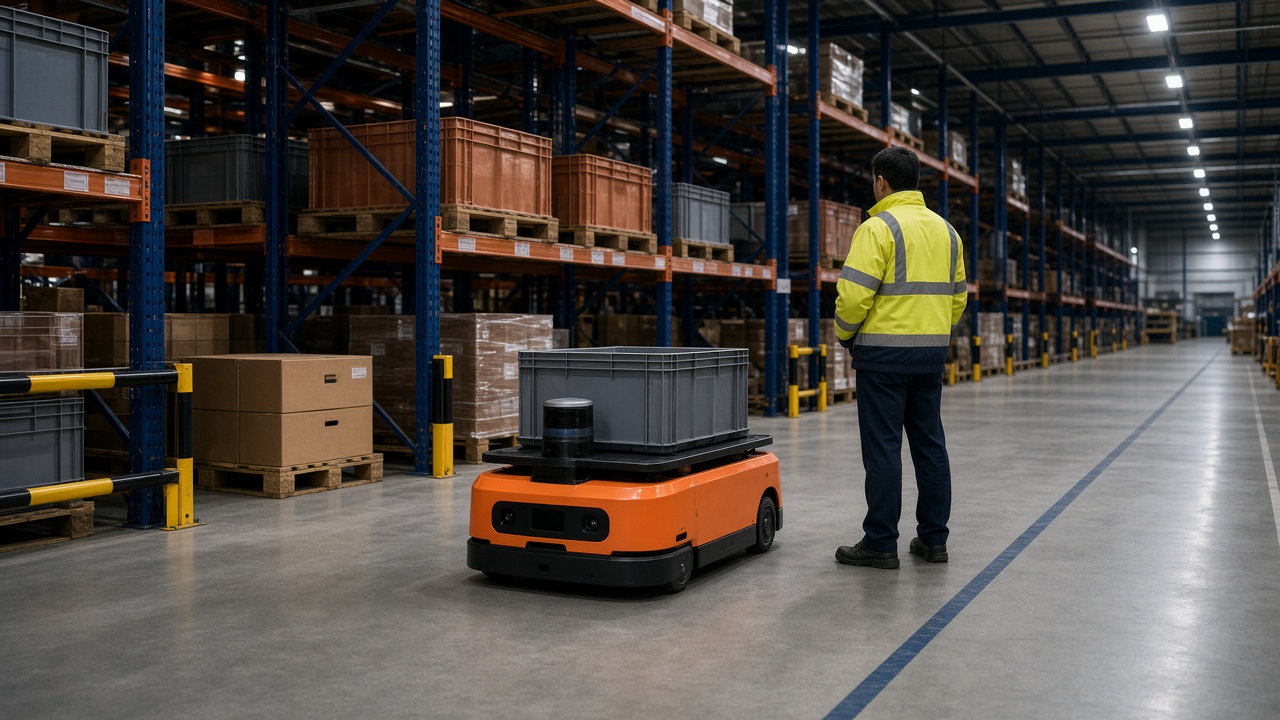
Mobile robots
AMRs — Autonomous Mobile Robots
Free-navigation mobile robots for factories, warehouses, hospitals & intralogistics fleets.
Mobile robots
AGVs & AMRs
Driverless industrial trucks, AMRs, and automated guided vehicles for factories and warehouses.
Mobile robots
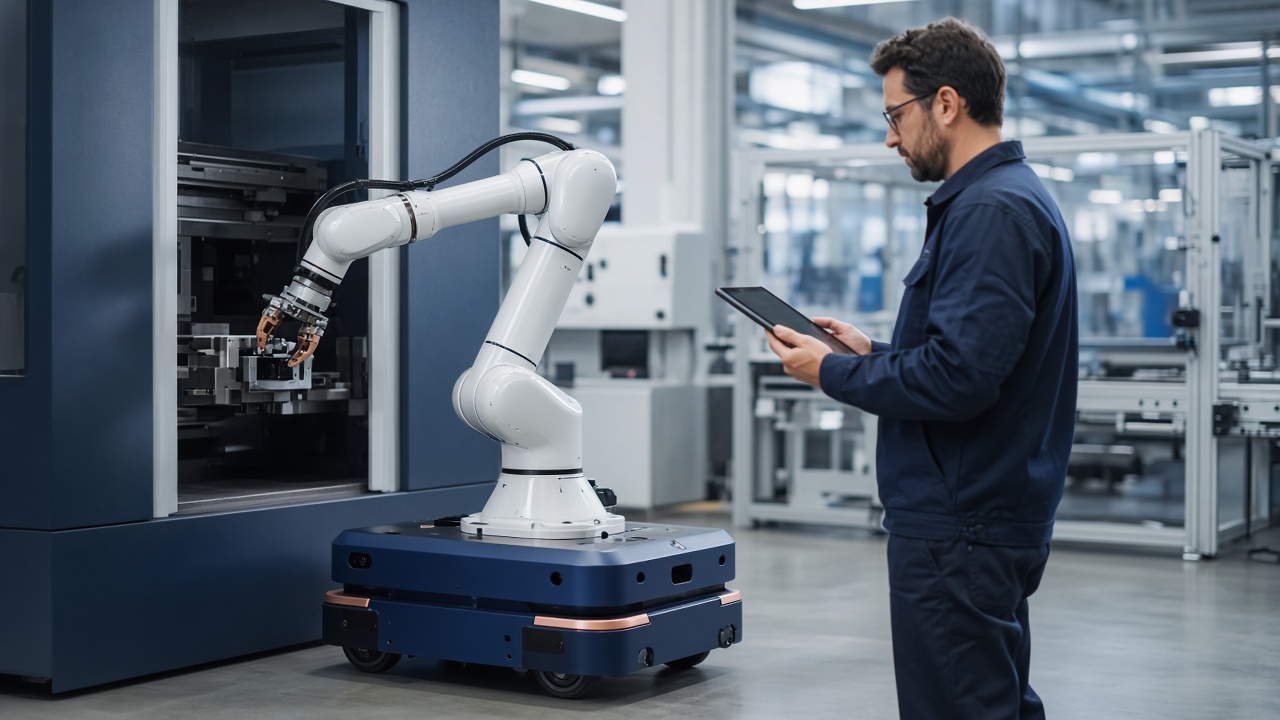
Mobile Manipulators (MoMas)
A mobile base plus a robot arm — combined navigation, manipulation, and collaborative risks.