
Collaborative & industrial robots · Primary: EN ISO 10218-1
Robot arm compliance for OEMs: ISO 10218-1 done properly
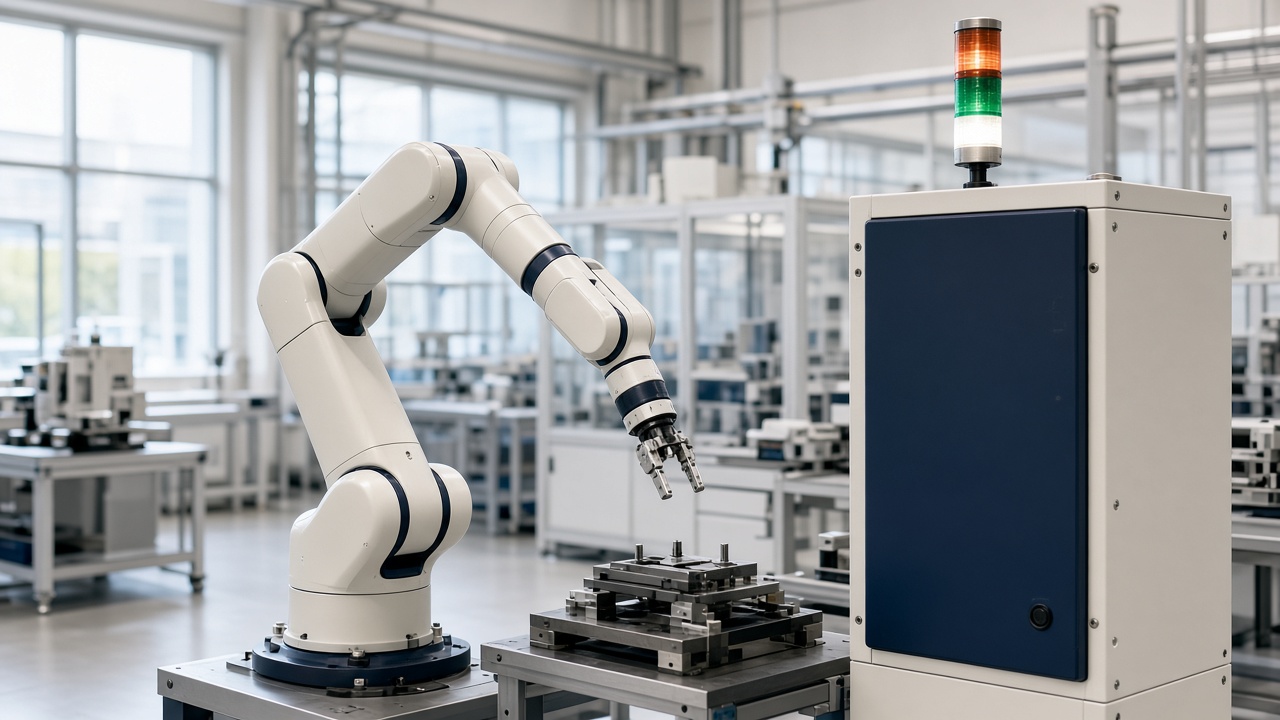
Robot arms as partly completed machinery and products — safety-rated motion control, stopping data, and integrator information that makes downstream cell assessments fast.
Built for: Robot arm OEMs (articulated, SCARA, delta, Cartesian) and safety-component suppliers
 EN ISO 10218-1
What this category actually demands
If you manufacture robot arms, ISO 10218-1 is your product standard: inherent design, protective measures, and the information for use that integrators will build on. Weak integrator information becomes your field problem when a cell is assessed and your manual cannot answer how a safety function behaves.
We help arm OEMs structure the 10218-1 evidence, safety-rated control functions (STO, SLS, SLP, safe position/speed monitoring), and integrator documentation so downstream ISO 10218-2 assessments go quickly — a genuine commercial advantage when integrators choose arms.
Reality check
Where Robot Arms programs stall
Safety functions listed, performance unproven
Claiming PL d for a monitored stop means architecture, diagnostics, and validation evidence — integrators and assessors will ask for all three.
Integrator manual written by marketing
Mounting, payload curves, stopping data, and safety I/O behaviour are compliance content. Vague manuals stall your customers’ DoCs.
Partly-completed status misunderstood
An arm sold for incorporation ships with a Declaration of Incorporation and assembly instructions — not a standalone CE story for a finished application.
Safety architecture — Robot Arms
The safety architecture we build with you
Every function below ends as a claim in your file — with a target performance level, an implementation, and a validation method. If one of these is missing for your product, that is where we start.
Safety-rated motion control
STO, safely-limited speed/position, and safe torque with defined PL/SIL capability.
Stopping performance data
Measured stopping time/distance data integrators need for separation calculations.
Protective stop interfaces
Category stops, enabling devices, and mode selection documented for cell design.
Integrator information pack
Residual risks, mounting/payload limits, and safety I/O behaviour written for ISO 10218-2 use.
How we help — from first sketch to site acceptance
One path, four gates. You keep design authority; we own the compliance thread through labs, assessors, and customer EHS reviews.
Gate 1
Domain & classification
Where it operates, who is exposed, which laws and type-C standards actually apply — before any test is booked.
Gate 2
Risk & safety architecture
ISO 12100 assessment turned into safety functions with PL/SIL targets your controls team can implement.
Gate 3
Validation
Measurements and tests on the real configuration — payload, speed, workpiece, ground — that close each safety claim.
Gate 4
File & acceptance
Technical file, DoC/DoI, instructions, and the site/customer acceptance pack, with change control that keeps it valid.
What you receive
- ISO 10218-1 clause evidence map
- Safety-function PL/SIL substantiation
- Measured stopping performance data pack
- Declaration of Incorporation & assembly instructions
- Integrator information manual review
Standards, in context
These are starting points, not a shopping list. The applicable editions and clauses follow from your classification and markets — EU Machinery Regulation (EU) 2023/1230, UK machinery rules, or North American OSHA/ANSI expectations, layered with EMC, electrical, radio, and battery law where your product triggers them.
Go deeper: Cobots & ISO/TS 15066 — where arm claims meet applications →
| EN ISO 10218-1 | Robots — safety requirements for robot manufacturers |
| EN ISO 13849-1 / IEC 62061 | Safety-related control systems (PL / SIL) |
| EN IEC 60204-1 | Electrical equipment of machines |
| Machinery Regulation (EU) 2023/1230 | Partly completed machinery & DoI route |
Questions we hear from Robot Arms teams
Does our arm ship with CE marking?+
An arm sold for incorporation is usually partly completed machinery with a Declaration of Incorporation, not a finished-application CE story. The integrator completes it.
Bring us your project — at any stage
Sketch, prototype, or a customer audit next month. A 30-minute scoping call maps your domain, standards, and evidence gaps.
Book Free CallKeep exploring Robotics
All Robotics →
Collaborative & industrial robots
Cobots & Collaborative Applications
Collaborative robot applications — power & force limiting, hand-guiding, and speed/separation monitoring.

Collaborative & industrial robots
Industrial Robots & Robot Cells
Articulated, SCARA, delta, and Cartesian robots — fenced, interlocked, and integrated cells.

Collaborative & industrial robots
Humanoids & Legged Robots
Humanoid, quadruped, and bipedal platforms for industrial pilots and field deployment.